
Few things are more annoying than pulling clothes from the dryer only to find everything clinging together in a staticky mess. Thankfully, with a few simple tweaks to your laundry routine, you can reduce static cling, protect your clothes, and make laundry day a little less frustrating.
You know that feeling when you pull a shirt over your head and you hear that crackling static noise, you feel the clothing clinging to your skin, and then you realize your hair is poking out in all directions!?
Not only is static cling annoying, it can also make your clothes look wrinkled, feel uncomfortable (especially for those sensory kids), and even cause uncomfortable shocks.
The good news? Static cling is easy to control with a few simple habits, many of which will also save you some money and are better for your clothes.
Here are my favorite easy static cling fixes.
10 Ways to Reduce Static Cling
1. Use Less Dry Time: When clothing becomes too dry, it builds up electrical charges (which cause static cling), so I use medium-high heat (not hot heat) and usually take the clothes out of the dryer 10 minutes before it says they are dry.
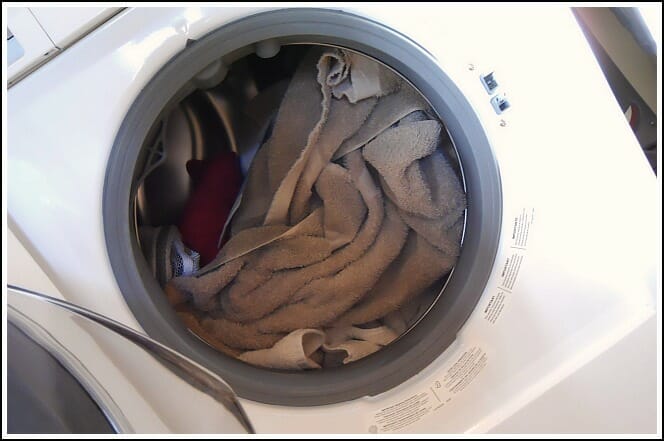
2. Add a Damp Rag: Put a damp rag/cloth in the dryer for the last few minutes of the dryer cycle. It provides just enough humidity to reduce much of the static cling. If you forget to add a damp rag before you hear the buzzer ring, simply add a damp rag to your already-dry clothing and run the dryer on low heat for 10 minutes.
3. Hang Clothes: If you have the time and the space, skipping the dryer altogether is a great option to eliminate static cling and extend the life of your clothing.
4. Dry Synthetic Fabrics Separately: If you can’t hang clothes to dry or catch the dryer before it’s finished drying, try separating synthetic fabrics like polyester, fleece, and athletic wear from cotton and natural fibers before putting them in the dryer. These fabrics tend to create more static, so separating those fabrics will reduce static in the rest of your laundry.
Also, cotton, linen, and natural fibers take much longer to dry than synthetic fabrics, so separating things allows you to use less time for the synthetic fabrics and more time for cotton.
5. Wool Dryer Balls: One of my favorite methods to reduce static cling is wool dryer balls. I started using them many years ago and have been impressed with how well they work. I leave my dryer balls in the dryer all the time and have used the same set for many years (it’s a good investment!)
NOTE: Tennis balls will also usually work for this — so if you have a few extra (clean) tennis balls lying around, give them a try!

6. Dryer Sheet: Duh… I know this one is obvious, but I couldn’t make a list of ways to reduce static cling without including the most obvious option. We don’t use dryer sheets regularly in our dryer, but I do keep a handful in the laundry room in case we’re struggling with static cling as we’re walking out the door. Simply rub a dryer sheet inside your clothing (wherever it’s clinging to you), and your problem is instantly solved!
This is also a great option for on-the-go, as it’s easy to keep a few dryer sheets in a zip-top bag inside your purse, carry-on, diaper bag, glove box, etc. Bonus: your bag/car will smell great too!
7. Hair Spray: Spray a bit of hairspray on the clothing that’s sticking to you, and your problem should be solved. I remember being a bit hesitant to try this because I thought it would make my clothes sticky, but it didn’t.
FUN FACT: If you have an ink stain on your clothing, spray the stained area liberally with hair spray before washing, and it should take the stain out.
8. Safety Pins: I had never heard of this before trying it, but I was surprised how well it worked. I used 4 safety pins total, and everything came out static-free! I have a friend who safety pins every pair of socks together before washing them… so her safety pins reduce static cling and make sorting socks super easy.
9: Vinegar while washing: I used vinegar in my laundry for a long time as it worked to reduce static cling and keep my machine clean. However, you should not use vinegar with OxiClean, and I really like using OxiClean for stains, so I don’t use vinegar for static cling anymore. If you’re wondering, you cannot smell the vinegar on your laundry.
10. Use Less Detergent: One final tip that will save you money (in addition to that static) is to simply use less detergent when washing your clothes. You might need to experiment with this a bit, but whatever the suggested amount of detergent is on your packaging, you can certainly use less. I probably use half the recommended amount with a 1 Tbsp. of OxiClean for almost all my laundry.

BONUS TIP: We’ve had good luck by simply putting lotion on before getting dressed (this is my favorite goat’s milk lotion). Might be worth a try in a pinch!
The Method I Use Most
I use wool dryer balls as my preferred method to stop static cling. If, for some reason, a specific item of clothing is still staticky, we use a dryer sheet or hairspray in the moment.
What are your best static cling solutions?
CYNTHIA PRICE says
This is exactly what Im looking for…I google searched for a way to get rid of static clong in the dryer withought using dryer sheets
Andrea says
yay — glad to help, Cynthia!
Bethany says
Regarding the use of vinegar in the washer, check with your manufacturers and/or owner’s manuals. Consumers Report warns against using vinegar:
“Vinegar is sometimes used as a fabric softener or for getting rid of stains and odors in laundry. But as with dishwashers, it can damage the rubber seals and hoses in some washing machines to the point of causing leaks. It’s a problem that Steven Grayson, owner of Foothills Appliance Service in Wilkesboro, N.C., sees fairly frequently. “With continual use, vinegar can literally melt hoses, causing leaks and thereby possibly all kinds of additional damage to the house,” says Grayson. In his experience, front-load washers are especially susceptible to vinegar-related damage.” AND “some dishwasher manufacturers warn that the acetic acid can eat away at the rubber parts in the appliance. “There are dozens of rubbers out there with different chemical compositions, some of which react with vinegar and some that do not,” Glajch says. “If you don’t know what kind of rubber is in your appliance and the manual doesn’t say you can use vinegar, then don’t.”
Liz says
I’d really like to know how the safety pins are used when using vinegar?
My daughters dog is so hairy and the static is insane … help please !
Liz
arisa says
why do the clothes not cling as much if they are taken out of the dryer while slightly damp?
nechama says
Can you put the vinegar in with the fabric softener? Will try on my dryer. Nechama
Andrea says
I don’t think you’d want to use both. You would use vinegar IN PLACE OF fabric softener — they do the same thing.
Sheri says
I really want to use vinegar in the washer, but I have heard from other sites that it might not be the best thing for your washer, because it has not been tested as a laundry product. If I heard of someone using it for years in their washer with no problem, I would start using it today!
Andrea says
Hi Sheri,
I’ve honestly never heard of anyone saying that vinegar is bad for a washing machine — in fact, I’ve seen companies and brands recommend cleaning the washing machine with vinegar.
That said, I’ve personally be using vinegar in my washing machine for well over 5 years and have never had an issue. I use it in my dishwasher too.
Sheri says
Andrea,
Wonderful! I am doing it today!
Andrea says
hope you love it!
rachel says
You seriously did 347 loads of laundry? How do you even have enough things to DO that many loads in one week?! Did you wash everything separately? 😉
Julia says
Washing machine detergent and vinegar mixture will remove the static cling much easily with the washing machine.